Hurling goalies wearing half zips has weirdly caught on
Hurling keepers wearing tracksuit bottoms in the 90s always seemed to involve the keeper being awful
You’re spot on 
The only exception to the tracksuit rule was Gabor Kiraly at Crystal Palace
Brian Mullins was a decent tracksuit wearing keeper for Offaly in the 00’s.
3 Likes

He’s definitely in the minority
Wasn’t there a roaster Dublin keeper who used to wear rugby flanker boots to toe peg his kick outs?
There was always a skinny indie hairstyle guy on Gaelic football teams who was about 5ft but brilliant.
John o Leary. ‘Long, hard and up the middle like your granny got it’ was how i heard his kick outs described by a discerning student of the game.
7 Likes
Another reason I forgot: The dressing rooms no longer being in the corner.
Teams running out from that corner where the Canal End met the Hogan Stand was special. They’d suddenly emerge, sometimes like a tube train bom-bam-bam-bam-bombing into a station but often like an express train accelerating out of a tunnel. Again this sight was particularly impressive if you were on Hill 16. It was the distance away you were, the background of the Canal End and the mountains away in the distance.
The best run outs I ever saw were those at the 1995 All-Ireland football final. The September air that day was some of the best ever experienced. John O’Leary being at the head of the Dublin run out brought both a feeling of great calm and extreme gravitas. John O’Leary was a serious man who didn’t frown but didn’t smile either. He always had the same look on his face. Business. His goalkeeper boots made him look like a serious man. The way he carried his gloves made him look like a serious man. Even though you couldn’t see his face from Hill 16 you knew he had the same look on his face as he always did. Dublin didn’t sprint but they didn’t shuffle either like some of the cute hoor teams used to do. Neither did Tyrone sprint out which was surprising as the hungry teams with hungry supporters tended to sprint out. Down in '91 sprinted out. Derry in '93 sprinted out. When the Tyrone team came out, the din of the klaxons was deafening. The red and white flags on the Canal End with the Toyota clock and the mountains. The parade then and flares and smoke on that end. It wouldn’t have been the same had the teams come out from the centre. Coming out from the centre doesn’t give you the necessary distance to run, to sprint onto the pitch in the proper fashion. The run outs from the Canal End corner were always that bit better for the team warming up at the Railway End because of the further distance they had to travel.
The old Wembley versus the new Wembley had the same thing going on. The walk out at the old Wembley was all about distance. The teams came up the tunnel and out at the furthest curved point of the dog track, then they had the long walk to line up in front of the Royal Box a quarter of a mile away. Now the teams walk out at the half way line and line up five yards onto the pitch.
What made that tunnel at the Canal End great was not just the location but that it was a proper tunnel. Tunnels are supposed to be dark, forbidding places. It wasn’t even just a tunnel, it was an actual cage, which increased the forbidding nature of ever more. You didn’t go in there, even though back in the day everybody went in there after an All-Ireland final, especially the lads giving out the celebratory milk bottles with actual milk inside, and priests. The tunnel looked dark, it was a cage, and sometimes what happened in there would be talked about but nobody would ever really know what happened. Tunnel “incidents” in Croke Park took on this mythical air because of that darkness and that cage. They were the box office fights we never saw. Back then a serious current affairs programme could do a serious report on a Croke Park tunnel incident and be taken seriously, not like now, when there are cameras in the shite tunnel in the new Hogan Stand and the absurdity of what happens is obvious.
The best tunnels in Ye Olde Stadiums had cages. Villa Park had a cage. The Melbourne Cricket Ground had a cage. A cage was a statement that this pitch was a place where animal spirits ruled. And a cage was a statement that the showers afterwards would be cold, even if this was not technically true.
The old Croke Park had a proper “box” and a proper opening under the box. It didn’t actually lead to anywhere important - it led to the concourse - sorry, concrete, under the Hogan Stand and the warehouse like canteen with the supermarket style lino floor tiles which sold ham sandwiches stored in a rat dropping infested store room. The opening under the BOX was mainly used as a quick way out of the stadium by spectators who had had gone onto the pitch after a game. But it looked important because it had green wooden doors.
The tunnel in the new Hogan Stand is shite and the BOX above it is shite. The tunnel looks like a stairwell in an office block constructed in 2001.
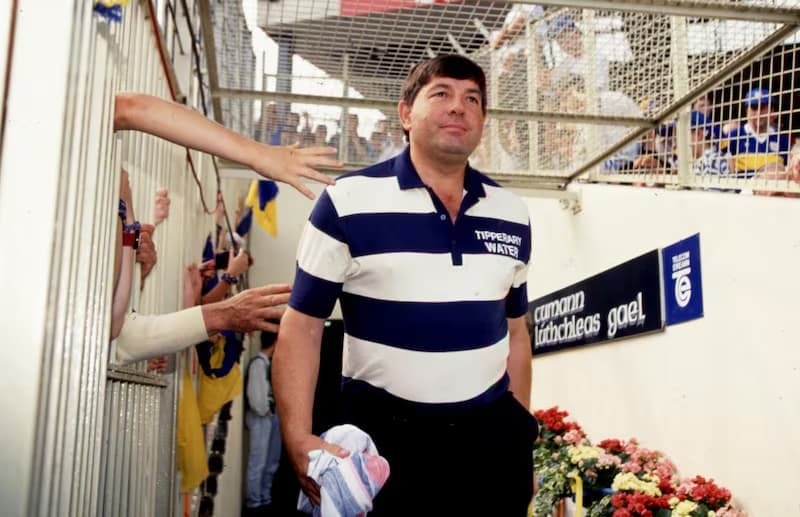
This photograph of Babs Keating is a tremendous showcase for the greatness of the tunnel, the cage. Look at the way that tunnel is dressed up for the day. Flowers! You don’t get flowers in the new Hogan Stand tunnel. You don’t have cage like gates. Gates slammed shut by the Maor who has been on duty since 1952. DJ Carey wouldn’t have got into that tunnel at 3:23pm on All-Ireland final day to pilfer a few 20 pound notes from his team mates.
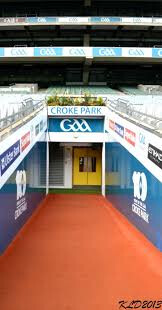
This “tunnel” is shite. You can see into it and you can see yellow doors like the ones that litter the corridors of Tallaght RTC or a 1980s community school.
5 Likes
I’d wager theres not a player anywhere in the GAA who would want those dressing rooms or that tunnel back.
1 Like
I remember reading a story, possibly in Nicky English’s book, about Galway leaving the dressing room to run on to the pitch for an All Ireland in the late 80s.
The gate at the end of the tunnel was locked and some janitor type fella informed them that they would have to wait a couple of minutes as RTE wanted to show live footage of Galway emerging onto the pitch but their coverage was currently on an ad break.
Brendan Lynskey made his way to the top of the queue and whatever was said to the key holder the gate was opened about 5 seconds later.
3 Likes
Lynskey probably ran through the gate and cut himself on the forehead.
you should be writing for the GAA match programmes
there aint much good in them but some of your observations would make for great reading which they dearly are in need of
2 Likes
Some stunning September air from the streets of Dublin on the evening of September 17th, 1995 in the last minute and a half of this 2 minute clip. It looks like it happened the weekend just gone.
https://www.rte.ie/archives/2020/0901/1162554-dublin-fans-celebrate/
3 Likes
Magic 
Cathal Casey was a smashing hurler
Brendan Lynskey getting a blood soaked head wound patched up on the sideline was a near ubiquitous feature of Galway matches in the late 80s and early 90s.
1 Like
The tunnel in the old PUC was fantastic.
The stewards would have to block off both sides of the concourse to allow the teams run from the dressing rooms to the pitch.
You could get a real feel on the intensity levels or lack of as the teams ran out.
They really were ahead of their time. Spurs charge top dollar for their hospitality guests to get the same view through glass walls these day.
That’s fantastic stuff. I was on the hill for that match. You kind of are right about it looking fairly timeless. That aroo Cha Cha messing at the end was total joe.ie social media performative stuff but they were doing it for the pure craic.
1995 was modern. It was more modern than now is. I use the word modern in that 1995 was a point where popular culture as we understand it still just about had some ideas before it ran out of ideas and started its turn back towards the past, though the turn back was already beginning to start. It was before the point where politics had completely run out of ideas and, driven by dystopian technology, started its turn back towards the darkest ideas ever created. It was still in the period where you felt humanity was on an upward curve rather than a downward one. That said, the summer of 1995 was also dominated by news of a genocide, but it at least felt like a conflict which had a chance of coming to some sort of uneasy resolution in the not too distant future, and it did.
I have a half baked theory that in the future people will look at things which look like they happened yesterday, but they will have happened 100 years ago, and all the people in them are dead, and this will cause great mental anguish and disorientation in the people watching these things. It will cause great self loathing among massive amounts of people. In fact this phenomenon is clearly already unfolding.
In 1995, if I was to see a clip of 1965, it was black and white and everything looked different. It looked OLD. Things which look OLD mean the identification on the part of the viewer automatically becomes less. When we look at the jumpy, grainy pictures of World War I and lads walking around on fast forward, the poor quality and funny play speed of the picture means we cannot fully comprehend these people as real human beings like us, they are like stone age creatures. joke people. Now you can look at clips of what happened at Clonliffe Road at 5:35pm on September 17th, 1995 and it literally looks like last Sunday. Even the 92D car which passes the junction near Meaghers has the roundy edges and corners and looks like one of today’s cars rather than a 1980s Datsun with the sharp edges and corners. There is nouveau Celtic Tiger brickwork on display in the surrounding buildings. Quite a few people in that clip are likely dead now. This is disorientating.
The preponderance of perfect colour, crystal clear picture material from the archives is progressively driving people cuckoo and destroying the current and future because there is now a widespread psychological phenomenon where people want to jump into old moving pictures and magically arrive in the past. This is a self reinforcing circle. The widespread obsession with the past and the longing for the past and knock on hatred of the present makes the present and the future worse.
1 Like
Ultimately it’s the visual images that will endure as the mental postcards of the 2025 All-Ireland hurling final.
Ronan Maher’s catch after 41 minutes was a beauty of an aesthetically pleasing and memorable image. It’s the switching of the camera shot that makes it. You see Maher approaching from the back on the panoramic bird’s eye view shot. Then the camera shot switches to the ground at the exact moment he catches the ball. Momentarily, on landing, he’s hidden by the referee on this new ground angle camera shot. You can sort of half see it, but you almost have to imagine him hitting the ground running with an almighty thud. Then he emerges from the forest. Leading the charge of the light brigade, as somebody once said.
This five seconds or so was an utterly classic visual image in the tradition of the warrior aesthetic. It was the image of a captain and a leader (captain leader legend innit) taking control, bringing gravitas to the situation.
In the inaugural Christmas 1991 edition of the Hurling and Football annual, the late GAA writer Raymond Smith of Tipperary wrote “Bury My Heart On The Killinan End”. He said that his wish was to die during the second half of a Tipperary v Cork Munster final at Thurles. His heart would simply give out. His lifeless body would somehow be passed backwards over the heads of the wedged in spectators, to the back of the terrace, where it would be gently and tenderly placed. Token resuscitation efforts would be made, but there would be nothing to be done, and a Tipperary flag would be gently placed over his corpse. Tipperary would win in epic fashion, and Smith’s lifeless body would later be carried out of the stadium and celebrated and wept both tearfully and joyfully over, like in a jungle tribe in Borneo, celebrated as the martyr like human sacrifice of this epic victory.
This catch by Maher fits the imagination as the sort of thing that would have tipped poor Raymond over the edge into the next life. Poor oul’ Raymond Smith died on Sunday the 2nd of April, 2000. That day Tipperary beat Cork in the National Hurling League in Pairc Ui Chaoimh. It wasn’t a Munster final and it wasn’t in Thurles but I suppose you can’t have everything.
4 Likes